

 The Local - Te Aro
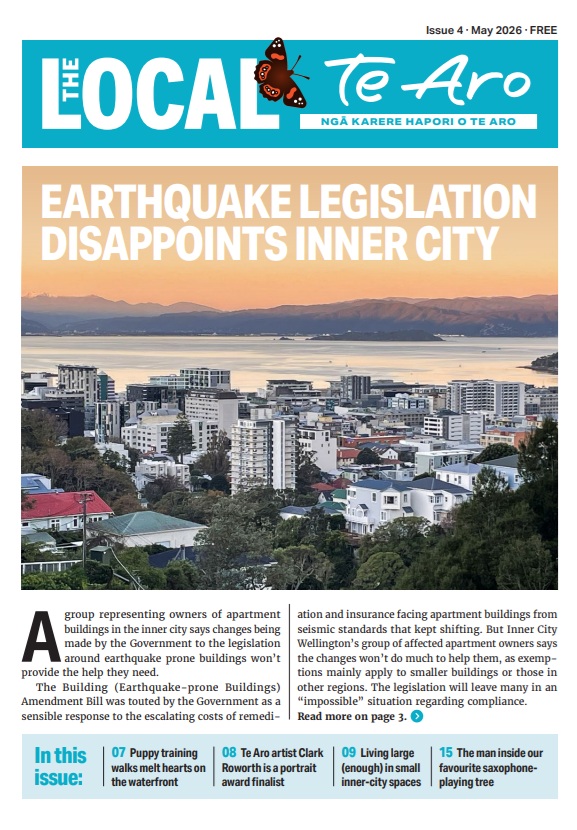
Owners of Wellington apartment buildings considered to be earthquake prone are feeling let down by proposed legislation changes that will do little to help them. Alex Brocklehurst reports.
A group of Wellington apartment owners say a new approach to regulate buildings’ seismic resilience won’t provide the relief they sorely need.
The Building (Earthquake-prone Buildings) Amendment Bill was introduced to Parliament last year, aiming to reduce costs for owners.
Although the changes will be significant for some – for example, Auckland, Northland and the Chatham Islands would be removed from the regime entirely – there was little change for large multi-unit buildings in Wellington.
Residents’ association Inner-City Wellington (ICW) told Select Committee that many of their members would see little to no difference in the costs and obligations they faced, and the treatment of apartment owners under the proposed changes continued to be “disproportionate, unfair and inequitable”.
ICW has estimated that at least 26 multi-owner buildings, with around 500 apartments and around 800 owners are among the residential earthquake-prone buildings in Wellington.
ICW called on government to provide a package of funding options to cater for owners’ different circumstances, such as suspensory loans, grants or buy-outs for buildings where remediation was deemed uneconomical.
“If this work is not done and reflected in the proposals, legislation will be passed knowing it will be impossible for many apartment owners to comply.”
But Chris Penk, Minister for Building and Construction, told The Local those options were not being considered in the current fiscal environment.
“However,” he said, “officials at MBIE have been working with stakeholders to identify practical ways to reduce costs and barriers, including for those in multi-unit developments. This includes options to streamline processes and make strengthening work simpler to deliver, for example considering whether certain façade securing work could be exempt from requiring a consent.”
The Wellington City Council anticipated that although the number of earthquake-prone residential buildings in the capital would be reduced by about half, the legislation as currently drafted wouldn’t see an equivalent reduction in the number of affected households, because the buildings that remained in scope tended to be larger complexes containing multiple units.
Geraldine Murphy, ICW’s spokesperson on earthquake-prone buildings, told The Local that the “mental stress” for apartment owners facing the prospect of losing their life savings, being unable to sell, finding it difficult to secure insurance, or threatened with enforcement action, had already taken its toll.
“They can’t move on, they’re trapped in this system and that translates into physical stress.”
Many apartment owners were retired or approaching retirement and saw their apartment as their ‘forever’ home. Some faced mortgage costs and body corporate fees, on top of increased cost of living pressures.
Geraldine said it was regrettable that government had again missed an opportunity to conduct a full analysis of the varying impacts on the different groups of owners subject to the regulations.
While the government had said it wouldn’t provide taxpayer cash to assist private owners, Geraldine said this wasn’t a tenable position.
“It is unreasonable to expect people to pay for remediation to get off a compliance list when it doesn’t make economic sense. Commercial owners wouldn’t do it, the Crown wouldn’t do it.”
Giving evidence to Select Committee, Lambton Ward Councillor Afnan Al-Rubayee called for “meaningful central government support”.
She told The Local apartment owners “have worked their entire lives, paid tax, done the right thing, so why is it now the system can’t support them?”
Wellington Central MP Tamatha Paul had also called for support to be included with the reforms. Writing to finance minister Nicola Willis and Mr Penk on April 8, she asked government to provide “clear and workable financial support pathways” for apartment owners in multi-unit buildings still required to complete remediation.
The Select Committee is due to report back by 16 June, before the Bill progresses to second reading.
OTHER STORIES
... loading ...